From Concept to Production: Closing the Operational AI Gap
The transformational potential of AI is no longer a matter of debate. Enterprise use cases are gaining serious traction, and organizations are moving decisively from controlled pilot programs to full-scale production deployments. Budgets are being reallocated, teams are being restructured, and the strategic conversation has shifted from "should we invest in AI?" to "how fast can we scale it?" Agentic AI — systems capable of autonomous decision-making and multi-step task execution — is already on the radar for many enterprises, promising a new frontier of intelligent automation. Yet for all this momentum, the path to enterprise-wide operational success remains frustratingly unclear for a significant portion of organizations.
The core obstacle is rarely the AI technology itself. What consistently derails enterprise AI initiatives is the absence of a coherent operational foundation: integrated data pipelines, stable automated workflows, and mature governance frameworks. As agentic AI matures and model autonomy increases, the stakes of getting this infrastructure right grow proportionally higher. Fragmented systems and data silos don't just slow AI adoption — they actively undermine it. Gartner projects that more than 40% of agentic AI projects will be cancelled by 2027, citing escalating costs, accuracy limitations, and unresolved governance challenges. The implication is stark: without the connective tissue of robust integration, even the most sophisticated AI models will stall at the pilot stage.
To cut through the noise and establish a clearer picture of how organizations are actually structuring their AI operations, MIT Technology Review Insights surveyed 500 senior IT leaders at mid- to large-size companies across the United States — all actively pursuing AI initiatives in some capacity. The goal: to identify what separates organizations that are successfully deploying AI at scale from those still caught in an endless cycle of experimentation.
The survey findings, supplemented by a series of in-depth expert interviews conducted in December 2025, reveal a consistent pattern: organizations with a strong integration foundation are significantly more advanced in their AI implementations and far better positioned for enterprise-wide rollout. As AI technologies proliferate and workflows grow increasingly autonomous, an enterprise integration platform emerges not as a nice-to-have, but as a critical enabler — one that prevents duplication, eliminates data silos, and provides the operational visibility needed to govern AI responsibly at scale.
Among the report's most significant findings:
Measurable AI progress is emerging across the enterprise landscape. Contrary to the narrative of widespread AI stagnation that has dominated recent industry discourse, the data tells a more encouraging story: three in four (76%) surveyed organizations report at least one department with an AI workflow fully operational in production. This signals a meaningful inflection point — AI is no longer purely aspirational for the majority of enterprises surveyed.
Structured, well-defined processes remain the most fertile ground for AI success. Nearly half (43%) of organizations are achieving their strongest AI outcomes when applying the technology to clearly scoped, already-automated processes — areas where data flows are predictable and success metrics are well established. A quarter are finding traction with net-new processes, while one-third (32%) are taking a broader, cross-functional approach across varied workflows. The pattern suggests that AI performs most reliably when it augments existing operational rigor rather than attempting to impose structure where none exists.
Organizational ownership of AI remains fragmented and underdeveloped. Only one in three (34%) organizations have established a dedicated team responsible for maintaining AI workflows — a striking gap given the complexity of keeping production AI systems performant and compliant. Responsibility is distributed unevenly across the rest: 21% rely on central IT, 25% delegate to departmental operations, and 19% have no clear ownership model at all. This diffusion of accountability is a significant risk factor, particularly as AI systems grow more autonomous and the consequences of model drift or governance failures become more severe.
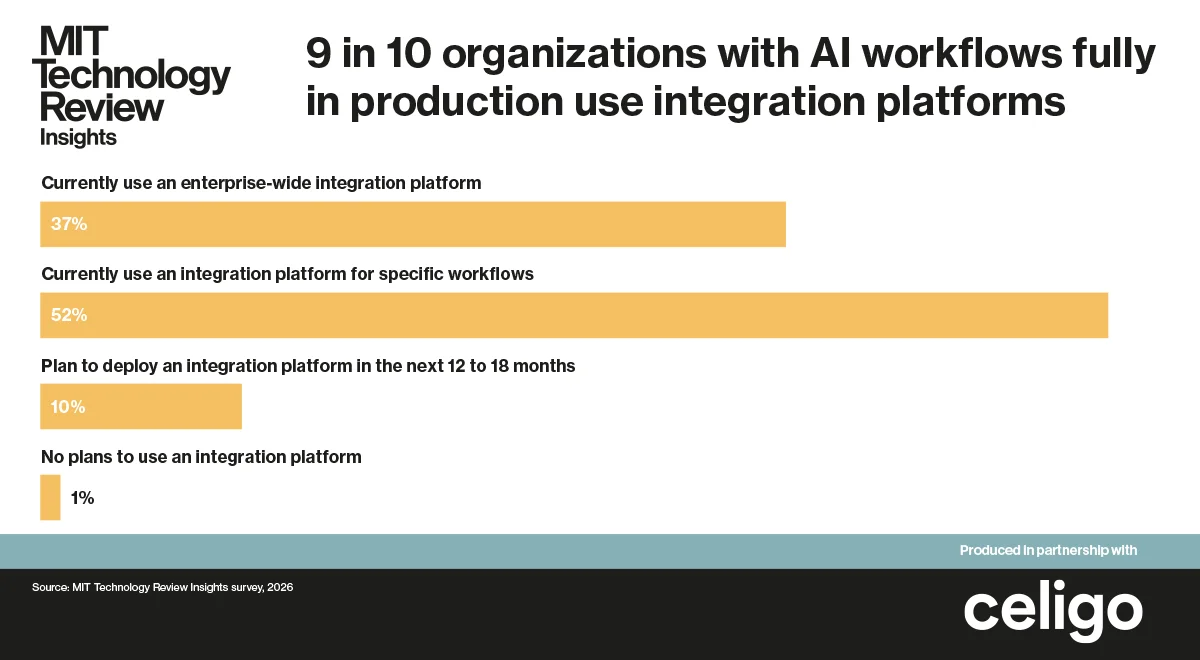
Enterprise-wide integration platforms are a force multiplier for AI maturity. Perhaps the report's most consequential finding: companies operating enterprise-wide integration platforms are five times more likely to leverage diverse, multi-source data in their AI workflows. Six in ten (59%) of these organizations draw from five or more distinct data sources, compared to just 11% of those using integration only for specific workflows — and 0% among organizations with no integration platform in place. The advantages extend beyond data breadth. Organizations with enterprise integration platforms also demonstrate higher rates of multi-departmental AI deployment, greater workflow autonomy, and stronger confidence in expanding that autonomy over time. In practical terms, integration infrastructure is the difference between AI that operates in isolated pockets and AI that delivers coordinated, organization-wide intelligence.
This content was produced by Insights, the custom content arm of MIT Technology Review. It was not written by MIT Technology Review's editorial staff. It was researched, designed, and written by human writers, editors, analysts, and illustrators. This includes the writing of surveys and collection of data for surveys. AI tools that may have been used were limited to secondary production processes that passed thorough human review.