Microsoft Brings On the Team Behind AI Collaboration Platform Cove
Microsoft has quietly absorbed another AI startup, this time pulling in the entire team behind Cove — a canvas-based AI collaboration tool backed by Sequoia Capital — as the product itself goes dark on April 1. The acqui-hire follows a familiar pattern in the current AI landscape: a well-funded startup with a sharp thesis gets absorbed before it can scale, with the team's expertise becoming the real prize. For Microsoft, it's another calculated move to deepen its AI talent bench as competition with Google, Apple, and OpenAI intensifies.
From Google Maps to an AI whiteboard
Cove was founded in late 2023 by Stephen Chau, Andy Szybalski, and Mike Chu, three engineers who previously worked on Google Maps products including Street View. Their pitch was straightforward but pointed: the standard chat interface for AI is too linear. A conversation window locks you into a single thread, making it hard to branch out, revisit earlier ideas, or reorganize your thinking. A spatial canvas, they argued, offered something fundamentally more flexible.
That critique of the chat paradigm wasn't just aesthetic. Anyone who has tried to use a large language model for genuinely complex work — research synthesis, project planning, iterative brainstorming — has likely hit the same wall. Scrolling back through a long thread to find a specific output, or trying to compare two different AI-generated responses side by side, is clunky at best. Cove's founders were betting that the next evolution of AI interfaces would look less like a messaging app and more like a spatial workspace.
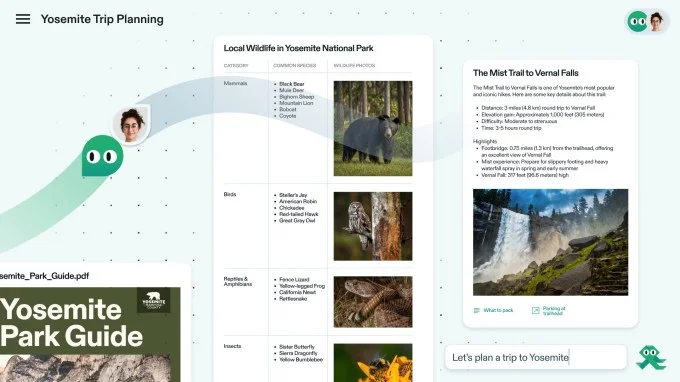
The product they built was an infinite whiteboard where AI could generate blocks of content — cards, tables, lists — in response to prompts. Users could pull in PDFs, images, and a built-in browser to give the AI richer context, then rearrange and edit the outputs directly on the canvas. Trip planning was one of the demo use cases, but the broader vision was a workspace where AI-generated content behaved more like editable material than a chat transcript.
The startup raised $6 million in a seed round in 2024, with Sequoia Capital leading alongside Elad Gil, Homebrew, Adverb, Scott Belsky, and Lenny Rachitsky. It was competing in a crowded space that included Miro, TLDraw, and Kosmik. Despite the competition, Cove carved out a distinct identity by treating AI as the primary collaborator on the canvas rather than a sidebar feature — a distinction that likely caught Microsoft's attention.
What the Microsoft acquisition actually means for users
Cove notified customers by email that the service is shutting down on April 1, with all user data deleted at that point. The company has refunded all March subscriptions and is offering a data export process for anyone who wants to retrieve their work before the deadline. Users who built workflows around the tool have a narrow window to act, and the abrupt timeline is a reminder of the inherent risk in building on early-stage AI products.
In a blog post, the team framed the move in optimistic terms: "When we started Cove, we set out to reimagine how people collaborate with AI. As model capabilities have accelerated, our conviction in that mission has only grown stronger. We're thrilled to continue this work at Microsoft AI, where we'll have the opportunity to pursue an even bigger vision." The company also noted that "the ideas behind it will live on" inside Microsoft — though what that looks like in practice remains unclear. Microsoft did not respond to requests for comment on how Cove's technology might be integrated into its existing products.
That silence is notable. Microsoft has a habit of absorbing teams and letting the integration story develop quietly over months before anything surfaces publicly. The Cove team's work may not appear in a product announcement for some time, if it ever does under a recognizable name.
Why Microsoft's whiteboard ambitions make this acquisition make sense
This isn't Microsoft's first move in the AI-powered canvas space. Back in 2023, the company added Copilot to Microsoft Whiteboard, its own collaborative visual workspace. Bringing in a team that spent over a year building specifically around the idea of AI-native spatial collaboration — not AI bolted onto an existing whiteboard — suggests Microsoft is thinking harder about what that product category could become.
The broader pattern here is worth watching. As foundation model capabilities improve rapidly, the differentiation for AI startups increasingly lives in the interface and interaction model, not the underlying model itself. Cove's founders recognized early that the chat paradigm has real limitations for complex, multi-directional thinking tasks. That insight, and the team's experience building it out, is likely what Microsoft is actually paying for.
Whether Cove's canvas-first approach eventually surfaces in a future version of Microsoft Whiteboard, Copilot, or something else entirely, the acquisition signals that Microsoft sees spatial AI collaboration as a serious design problem — one worth solving with dedicated talent rather than incremental feature updates.
The bigger picture: acqui-hires and the AI talent race
Cove's exit is part of a broader consolidation happening across the AI startup ecosystem. As the cost of building on top of foundation models drops, the number of well-designed but thinly differentiated AI tools has exploded — and the gap between a compelling demo and a sustainable business has never been more apparent. For many startups, an acqui-hire by a major platform isn't a failure; it's increasingly the expected outcome.
For Microsoft specifically, the move reflects a deliberate strategy of acquiring interface-layer expertise. The company already has the model infrastructure through its deep partnership with OpenAI. What it needs are teams who have spent real time thinking about how humans actually want to interact with AI at work — not in theory, but through months of user feedback, iteration, and hard-won product decisions. That's exactly what the Cove team brings.
It also raises a broader question about the future of AI collaboration tools. If the most promising teams in the space keep getting absorbed by Microsoft, Google, and Apple, the independent ecosystem for AI-native productivity software could thin out considerably. That's good for the platforms, but it may slow the pace of genuinely novel interface experimentation that startups tend to drive.
Cove may be shutting down, but the ideas it was built on — that AI deserves a more spatial, flexible, and human-centered interface than a chat window — aren't going anywhere. If anything, landing inside one of the world's largest software companies gives those ideas a much bigger stage. Whether Microsoft has the product discipline to act on them is the question worth watching over the next few years.