Most AI agents today suffer from a fundamental flaw: they forget everything the moment a session ends. Every conversation starts from scratch, with no memory of past preferences, prior decisions, or accumulated context. That limitation is increasingly unacceptable as developers push agents into real-world workflows that demand continuity. A growing set of memory frameworks is changing that — and choosing the right one can make or break your agent's usefulness.
Why Memory Is the Missing Layer in Most Agent Architectures
Stateless agents are fine for one-shot tasks, but they fall apart in anything resembling a real assistant relationship. Without persistent memory, an agent can't track user preferences, build on prior conversations, or accumulate domain knowledge over time. The engineering challenge isn't just storage — it's knowing what to store, when to retrieve it, and how to surface it without overwhelming the model's context window. That's where dedicated memory frameworks come in, each taking a different approach to the same core problem.
AI agent memory broadly covers five capabilities: storing and retrieving conversation history, managing long-term factual knowledge, implementing semantic memory search, handling context windows effectively, and personalizing agent behavior based on past interactions. The frameworks below each address some or all of these, with different tradeoffs in complexity, flexibility, and integration depth.
Six Frameworks Worth Building With
Mem0 is purpose-built as a memory layer for AI applications. It extracts and stores relevant facts from conversations, supports multi-level memory scopes (user, session, and agent), and uses hybrid retrieval combining vector search with metadata filtering. Built-in version control for memories is a practical touch that most alternatives skip. Start with the Quickstart Guide, then dig into Memory Types and Memory Filters.
Zep focuses on conversational memory specifically. It extracts entities, intents, and facts from dialogue and stores them in structured form. Its progressive summarization condenses long histories without losing key details, and it supports both semantic and temporal search — useful when you need to find what a user said last week, not just what's semantically similar. The Quick Start Guide and Zep Cookbook are good entry points.
LangChain Memory offers the broadest range of memory types — conversation buffer, summary, entity, and knowledge graph — backed by storage options ranging from in-memory to vector databases. Its main advantage is native integration with the rest of the LangChain ecosystem, making it the natural default if you're already building on that stack. The memory overview in the LangChain docs covers everything you need to get started.
LlamaIndex Memory is the strongest option for knowledge-intensive agents that need to reason over documents alongside conversation history. It combines chat history with document context, works with vector stores for semantic search, and handles context window management automatically. If your agent is doing retrieval-augmented generation alongside multi-turn conversation, this is worth a close look. The Memory in LlamaIndex overview covers both short and long-term memory patterns.
Letta takes the most architecturally distinct approach, drawing inspiration from operating system design to implement a virtual context management system. It intelligently moves information between immediate context and long-term storage, treating the LLM's context window like a managed resource rather than a fixed buffer. For agents with complex, evolving state, this model is worth understanding even if you don't adopt it wholesale.
What This Means for How Agents Get Built Going Forward
The proliferation of memory frameworks signals something important: the field is moving past treating memory as an afterthought bolted onto a chat loop. Dedicated tooling for memory retrieval, summarization, and context management is becoming a standard part of the AI engineer's stack, not an optional enhancement.
Each framework here reflects a different philosophy. Mem0 and Zep treat memory as a first-class service. LangChain and LlamaIndex embed it within broader orchestration frameworks. Letta reimagines context management at a systems level. None of them is universally the right choice — the best fit depends on whether your agent is primarily conversational, document-heavy, or managing complex long-running state.
The practical takeaway for engineers is to match the memory model to the agent's actual use case rather than defaulting to whatever ships with your orchestration framework. A customer support agent that needs to recall user history across sessions has different requirements than a research agent summarizing documents in real time. Getting that match right is what separates agents that feel genuinely useful from ones that just feel like a slightly smarter search box.
Memory is the unsolved problem sitting at the center of practical AI agent development. You can give an agent the best reasoning model available, but without a coherent way to store, retrieve, and update what it knows across sessions, it resets to zero every time. The six frameworks covered in this piece each take a different architectural stance on that problem — and two of the most technically distinct are Letta and Cognee.
Letta's OS-Inspired Approach to Context Management
Letta tackles the context window problem by borrowing a concept most developers already understand: the memory hierarchy of an operating system. Main context functions like RAM — fast, immediately accessible, but limited in size. External storage acts as disk — slower to access, but effectively unbounded.
What makes this more than a metaphor is that agents running on Letta can actively manage their own memory through function calls. They read, write, and archive information programmatically, deciding what stays in the active window and what gets swapped out. The result is an agent that can sustain coherent, long-running conversations without hitting a hard wall when the context fills up.
For developers building conversational agents that need to operate over extended timeframes — think multi-session assistants or support bots with deep user histories — this architecture removes one of the most frustrating constraints in the space. The Intro to Letta documentation is the right starting point, followed by Core Concepts and the DeepLearning.AI short course LLMs as Operating Systems: Agent Memory for a deeper conceptual grounding.
Cognee Treats Memory as a Knowledge Graph, Not a Text Store
Cognee takes a structurally different position. Where most memory frameworks store information as retrievable text chunks, Cognee builds knowledge graphs from unstructured data — meaning agents don't just retrieve facts, they reason over the relationships between them.
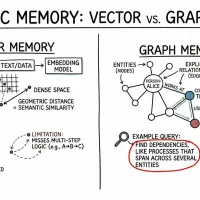
That distinction matters more than it might initially seem. Vector search finds things that are semantically similar. Graph traversal finds things that are structurally connected. Cognee combines both, which means a query doesn't just surface relevant text — it surfaces relevant context, including how concepts relate to each other across different sources.
The framework supports ingestion from documents, conversations, and external data feeds, and includes pipelines that let the knowledge graph evolve continuously as new information arrives. For agents that need to build and maintain a rich, structured understanding of a user or domain over time, this is a meaningfully different capability than what vector-only approaches offer. The Quickstart Guide and Setup Configuration docs are the practical entry points.
Why the Choice of Memory Architecture Has Real Downstream Consequences
The frameworks covered across this series — Mem0, Zep, LangChain, LlamaIndex, Letta, and Cognee — aren't interchangeable. Each one reflects a specific theory about what agent memory actually needs to do. Letta optimizes for continuity across long conversations. Cognee optimizes for relational depth. Mem0 and Zep lean toward user-level personalization. LangChain and LlamaIndex offer flexibility for document-heavy research workflows.
Picking the wrong one doesn't just create technical debt — it shapes what your agent is fundamentally capable of. An agent built on a flat vector store will always struggle with relational reasoning, no matter how well you tune the retrieval. An agent without context window management will always degrade over long sessions.
The practical projects worth building to develop real intuition here include a preference-learning personal assistant with Mem0, a customer history agent with Zep, a document research agent with LangChain or LlamaIndex, a long-context conversational agent with Letta, and a structured user intelligence system with Cognee. Each one forces you to confront the tradeoffs directly rather than just reading about them.
The memory problem in AI agents is genuinely hard, and no single framework solves it universally — but the tooling available heading into 2026 is sophisticated enough that the right choice for most use cases is now a matter of matching architecture to requirements, not waiting for the technology to catch up.