Google Expands Gemini AI Integration in Chrome to Indian Users
Google's AI ambitions just got a lot more global. The company is extending Gemini's presence inside Chrome to users in India, Canada, and New Zealand — a meaningful step beyond its original U.S.-only debut last September, and one that comes with notably broad language support for the Indian market. The move reflects a broader strategic push by Google to embed AI assistance directly into the browser layer, making it ambient rather than something users have to actively seek out.
What the Gemini sidebar actually does in Chrome
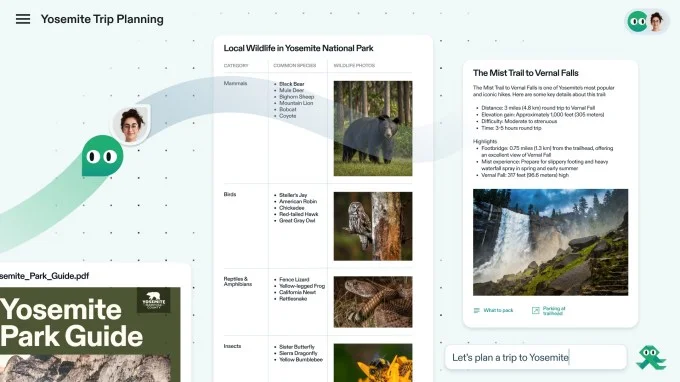
The feature surfaces as an "Ask Gemini" icon on the tab bar. From there, users can pull up a sidebar on desktop and interact with whatever is on screen — summarizing articles, generating quizzes from content, or asking follow-up questions without switching tabs. The cross-tab functionality is one of the more practical additions: you can reference multiple open tabs simultaneously, which makes side-by-side comparisons — say, two flight options or competing product listings — considerably less tedious.
Gemini in Chrome also hooks into Google's broader app ecosystem. Gmail, Maps, Calendar, YouTube, Keep, and Drive can all feed into responses, letting users compose emails, schedule meetings, or get a YouTube video summarized with timestamp markers — all without leaving the browser window. A separate capability powered by Google's Nano Banana 2 model lets users upload images and visualize changes, like previewing how a piece of furniture might look in a room photo.
That image capability is worth pausing on. Running locally via the Nano Banana 2 model means it doesn't require a round-trip to Google's servers for every query, which has implications for both speed and privacy. It's a sign that Google is thinking carefully about where to run inference — on-device for lightweight, personal tasks, and cloud-side for heavier reasoning — rather than defaulting everything to the cloud.
On mobile, Google is rolling out Gemini support in Chrome for iOS specifically in India, accessible through a page tools icon in the address bar.
India gets first-class language treatment
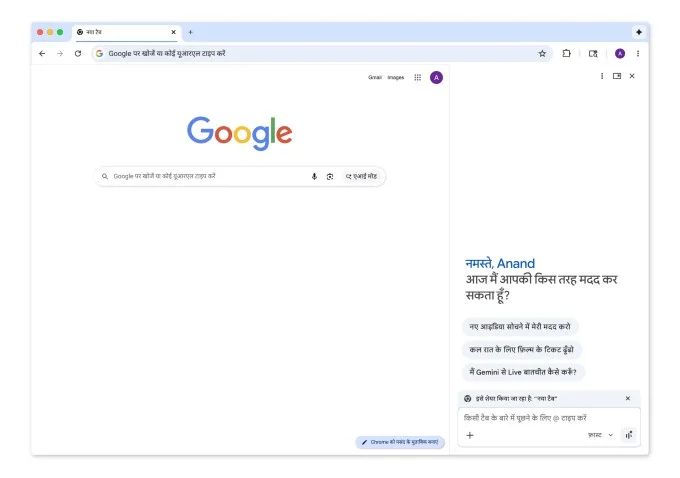
The regional expansion isn't just a geographic checkbox. Google is adding support for Hindi, Bengali, Gujarati, Kannada, Malayalam, Marathi, Telugu, and Tamil — eight Indian languages on top of English and Chrome's other newly supported languages. That's a deliberate move to make Gemini usable for a much wider slice of India's internet population, not just English-fluent urban users. For a market where regional language content consumption has been growing steadily, this kind of native-language AI assistance inside the browser carries real weight.
India has over 600 million internet users, and a significant portion of that base browses, reads, and communicates primarily in regional languages. Hindi alone has hundreds of millions of speakers, but languages like Tamil, Telugu, and Bengali each represent tens of millions of active internet users who have historically been underserved by AI tools built with English-first assumptions. By launching with eight Indian languages from day one rather than treating them as a future add-on, Google is signaling that this isn't a token localization effort.
It also positions Gemini competitively against local and regional AI players who have been building language-specific tools for Indian markets. Google has the distribution advantage of Chrome's dominant browser share in India, and pairing that reach with genuine multilingual capability is a harder combination for competitors to match.

Why the agentic holdback matters
There's a notable gap in what's being offered internationally versus what U.S. users already have. In January, Google rolled out agentic capabilities for American AI Pro and AI Ultra subscribers — features that let Gemini autonomously take over browser tasks on a user's behalf. That functionality is explicitly excluded from this expansion to India, Canada, and New Zealand.
The distinction signals something about how Google is staging its most powerful AI features. Agentic browsing — where an AI can navigate, click, and act independently — carries a higher bar for trust, reliability, and likely regulatory consideration. Rolling it out in the home market first, then watching how it performs before extending it globally, is a cautious but logical approach. It also means the international rollout, while broad in language and geographic scope, is still a tier below what Google's most premium U.S. users are getting.
The regulatory dimension here shouldn't be underestimated. Canada and the EU have both been active in scrutinizing AI deployments, and India is in the process of developing its own AI governance framework. Agentic features — where an AI takes real-world actions on a user's behalf — are precisely the kind of capability that regulators are most likely to examine closely. Holding those features back while the policy landscape matures is a way of managing that exposure, even if Google doesn't frame it that way publicly.

What this means for the browser wars
Embedding Gemini into Chrome isn't just a product feature — it's a strategic move in an increasingly competitive browser landscape. Microsoft has been aggressively integrating Copilot into Edge, and the battle for AI-native browsing is very much underway. For Google, Chrome's roughly 65 percent global market share gives it an enormous distribution channel for Gemini that no standalone AI app can replicate. Every Chrome user who encounters the "Ask Gemini" icon is a potential touchpoint for Google's AI ecosystem, and that scale matters enormously when you're trying to build habitual AI usage.
There's also a monetization angle worth watching. The agentic features currently limited to U.S. AI Pro and AI Ultra subscribers suggest Google sees the browser as a vehicle for driving subscriptions to its premium AI tiers. As those features eventually expand internationally, the browser becomes not just a distribution channel but a conversion funnel — nudging users toward paid plans by surfacing capabilities they can't access on the free tier.
The bigger picture
Google has been steadily deepening Gemini's role inside Chrome since the floating window experiment last September, and the shift to a persistent sidebar earlier this year made the integration feel less like a bolt-on and more like a core part of the browser. Expanding that to three new regions — with genuine multilingual depth in India — suggests the company is moving toward making Gemini a default layer of the browsing experience worldwide, not just a feature for early adopters in one market. The agentic gap will close eventually, and when it does, the infrastructure for a truly global AI-native browser will already be in place. That's the longer game Google appears to be playing here, and this rollout is a significant move toward it.