Why AI Apps Hook Users Fast but Struggle to Keep Them Long-Term
Slapping an AI label on your app might boost early revenue, but it won't keep subscribers around. That's the blunt takeaway from RevenueCat's 2026 State of Subscription Apps Report, which draws on data from over 1 billion in-app transactions and more than $11 billion in annual developer revenue — making it one of the more credible windows into how subscription apps are actually performing across iOS, Android, and the web.
AI apps win the conversion battle, lose the retention war
The numbers tell a split story. On the front end, AI-powered apps outperform their non-AI counterparts by a meaningful margin. Trial-to-paid conversion rates sit at 8.5% for AI apps versus 5.6% for non-AI apps — a 52% advantage. Download monetization is also roughly 20% better, and monthly realized lifetime value (RLTV) comes in at $18.92 for AI apps compared to $13.59 for non-AI apps. Annually, that gap widens further: $30.16 versus $21.37.
So AI apps are clearly better at getting people to open their wallets. The problem is what happens next.
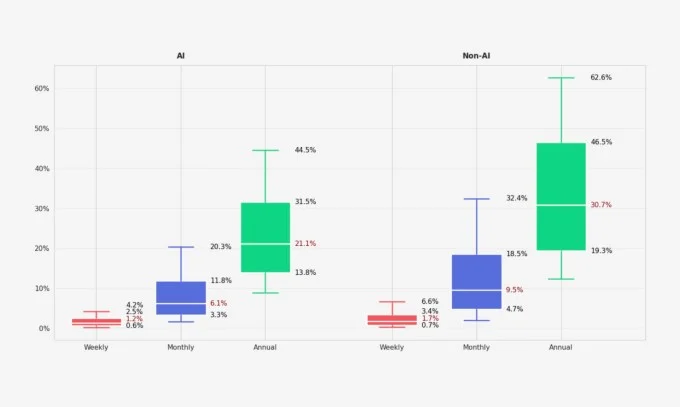
Annual subscriber retention for AI apps sits at 21.1%, compared to 30.7% for non-AI apps. Monthly retention follows the same pattern — 6.1% versus 9.5%. Annual churn, the rate at which subscribers cancel, runs 30% faster for AI apps at the median. The one exception is weekly subscriptions, where AI apps edge ahead with 2.5% retention versus 1.7%, though weekly plans aren't a dominant format in this category.
Refund rates point to a deeper value problem
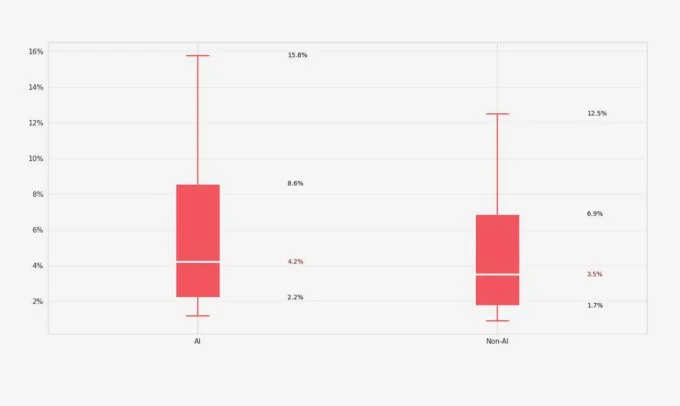
Beyond churn, refund behavior adds another layer of concern. AI apps carry a 20% higher refund rate than non-AI apps — 4.2% versus 3.5% at the median. More telling is the upper bound: 15.6% for AI apps against 12.5% for non-AI apps. RevenueCat flags this as evidence of "greater volatility in realized revenue and deeper issues in user value, experience, and long-term quality."
That's a pointed diagnosis. Higher refund ceilings suggest that a meaningful subset of AI app users feel strongly enough about their disappointment to actively seek their money back — not just quietly cancel.
What this means for developers betting on AI as a monetization strategy
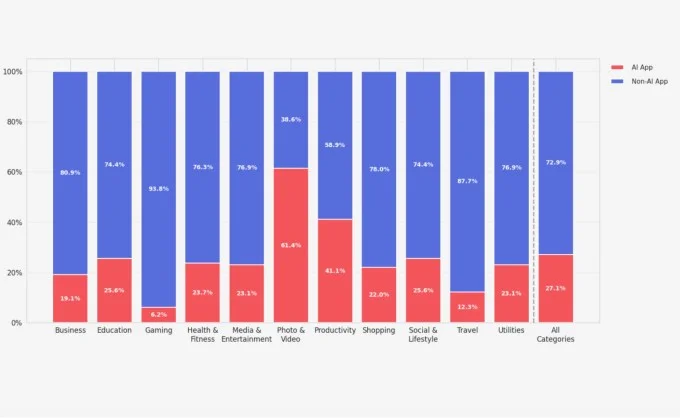
RevenueCat's platform is used by over 75,000 app developers, so the data isn't a niche sample — it reflects broad behavior across the subscription app market. Currently, AI-powered apps account for 27.1% of apps on the platform, with Photo & Video leading adoption at 61.4% and Gaming trailing at just 6.2%. Travel (12.3%) and Business (19.1%) are also relatively low on AI integration.
The pattern emerging from this data has real strategic implications. AI features are effective at generating initial excitement and converting curious users into paying subscribers. But that enthusiasm appears to fade quickly, likely because the technology itself is moving so fast that users keep jumping to whatever app has the most current capabilities — or because the apps simply aren't delivering enough sustained value to justify ongoing payments.
For developers, the implication is that AI integration alone isn't a business model. Strong conversion metrics can mask a leaky retention bucket — and if users are churning 30% faster and requesting refunds at higher rates, the long-term unit economics get uncomfortable fast. The apps that figure out how to hold onto subscribers after the novelty wears off will be the ones that actually build durable businesses around AI.
The AI app boom is real, but the data suggests it's running on hype as much as habit — and hype doesn't renew subscriptions.