Sandbar Raises $23M Series A to Bring AI Note-Taking to Your Finger
Two former Meta engineers building a smart ring for voice notes might sound like a niche bet — but $36 million in total funding and a sold-out preorder batch suggest the market disagrees. Sandbar, founded by Mina Fahmi and Kirak Hong, has closed a $23 million Series A led by Adjacent and Kindred Ventures, and is now preparing to ship its Stream ring this summer.
What the Stream ring actually does
Unlike Oura and other health-focused rings, Stream is built around a single core behavior: capturing your thoughts. The ring sits on your finger with a microphone that stays off by default — you activate it by holding a flat, touch-sensitive panel on top. From there, you can record voice notes, interact with an AI assistant through the companion phone app, or control media playback.
There's a deliberate design choice baked into the hardware: the microphone is tuned for proximity, meaning you have to raise your hand toward your face to record. That's not a limitation — it's intentional. Adjacent's Nico Wittenborn, who led the round, sees this gesture as a signal of private intent. You're not passively recording a room; you're actively choosing to capture something. That distinction matters as ambient recording devices face growing scrutiny.
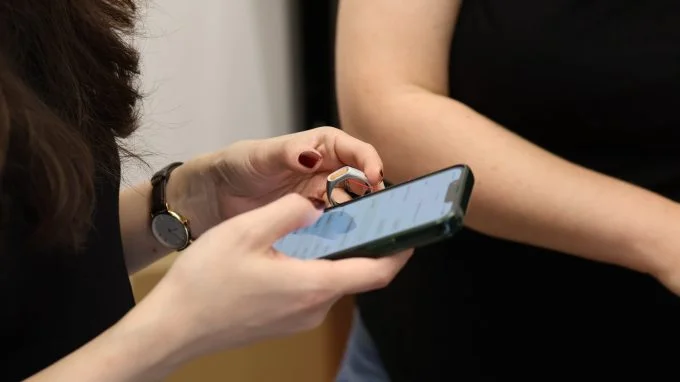
Fahmi, who previously worked at CTRL-Labs and Magic Leap before Meta, said the company spent over two years developing the ring before coming out of stealth. Early reception exceeded expectations — the first preorder batch sold out, prompting a second. Some users are reportedly triggering the ring more than 50 times a day for tasks ranging from trip planning to meal prep to presentation drafts.
Software is where Sandbar is placing its bigger bets
The ring is the entry point, but Fahmi is clear that the real product is the experience built around it. Sandbar is actively working on a web platform, tightening its UI, and cutting down model response latency. Longer term, the company wants to enable agentic workflows — letting users take direct action from their notes rather than just storing them.
Conversational continuity is a priority. Many users, Fahmi noted, ask the AI assistant about notes they didn't finish recording. The team is building toward multi-turn conversations — iterative exchanges where you might be working in a terminal and clarifying things by voice in real time, rather than issuing one-shot commands to a smart speaker.
The app currently requires the Stream ring to function, but Sandbar is weighing whether to open it up as a standalone tool — useful for when the ring is charging or simply not on hand.
A crowded category, but not a commoditized one
Sandbar is not operating in a vacuum. The AI note-taking hardware space has gotten noticeably busier. Plaud targets meeting capture. Pebble is going after the budget end with a $75 ring. Taya is positioning its wearable as jewelry to reach users who wouldn't otherwise wear a piece of tech. Omi is taking a different angle entirely with a brain-interface pitch.
What separates these products isn't just price or form factor — it's the intended user and use case. Wittenborn, who backed Blinkist during his time at Insight Venture Partners, believes much of the current AI hardware market skews toward a narrow early-adopter demographic. His read on Stream is that its design is accessible enough for broader adoption, not just the technically inclined.
That thesis is reflected in Sandbar's hiring plans. The company currently has 15 people, drawing from backgrounds at Amazon, Fitbit, Google, Apple, and Equinox. With the new capital, it intends to double its software and machine learning teams and bring on marketing staff — a signal that the product is moving from development mode into growth mode.
Sandbar's previous $13 million raise from True Ventures came just last November, bringing total funding to $36 million. The pace of that capital accumulation, combined with a summer ship date, puts real pressure on the team to deliver — and real momentum behind the idea that a ring on your finger might be the most natural way to capture a thought.